A.I. Policies in Price Setting Model Design (Upfront Work)
Our price optimization engines are built using advanced
statistical models that leverage A.I. (this has been true since our firm’s 2014
foundation). Our A.I. policies governing the underlying model designs are
anchored in the concepts of transparency, explainability, and human oversight:
We only use explainable A.I. models to optimize
price points. For example, we do not use neural networks, where the pricing
logic is a “black box” to all involved, including analysts. This means that price point calculations can
be understood and explained by analysts.
Our clients have access to all details about their
A.I. models. In fact, we often invest time in knowledge transfer, to ensure
that our clients understand how the models operate, and how pricing
recommendations are generated. This enables clients to conduct better informed reviews
of the pricing recommendations before implementation. This approach helps
ensure that resulting recommendations make sense for the business, that
stakeholder input can be considered, and that any necessary model adjustments
can be made in a responsive manner.
Clients with adequate capabilities can take
ownership of the A.I. models. While initially designing the pricing algorithms
tends to be a complex undertaking that requires significant sophistication and
more specialized tools, once the optimization models are built, existing or
low-cost solutions frequently suffice to keep them updated (some incremental
technology investments could be required).
Note about Dynamic Pricing and Machine Learning: Some clients desire a dynamic
pricing engine. We define dynamic pricing as a pricing system where the pricing
model itself (underlying segmentation scheme, pricing factors such as markups
or discounts) are continuously updated with relatively high frequency (often on
a weekly basis), resulting in price changes that may not be directly related to
core data such as cost fluctuations or changes in competitive price points.
This is in contrast with periodically updated pricing logic where absent
changes in core inputs (such as changes in cost, customer, or competitive
pricing data), pricing recommendations remain relatively stable between model
updates, as segmentation schemes and pricing factors are updated with less
frequency (perhaps a few times a year, when significant new data becomes
available, market conditions change, or business strategies shift).
The main benefit of a dynamic pricing system is the quickness and agility in
reacting to market changes. Some drawbacks include increased model complexity
and resource requirements, along with less pricing stability in general. For
example, dynamic pricing engines can drive customer-specific prices to
increase, despite no changes in costs or other core pricing inputs (and such
price changes may be best implemented with due care and monitoring).
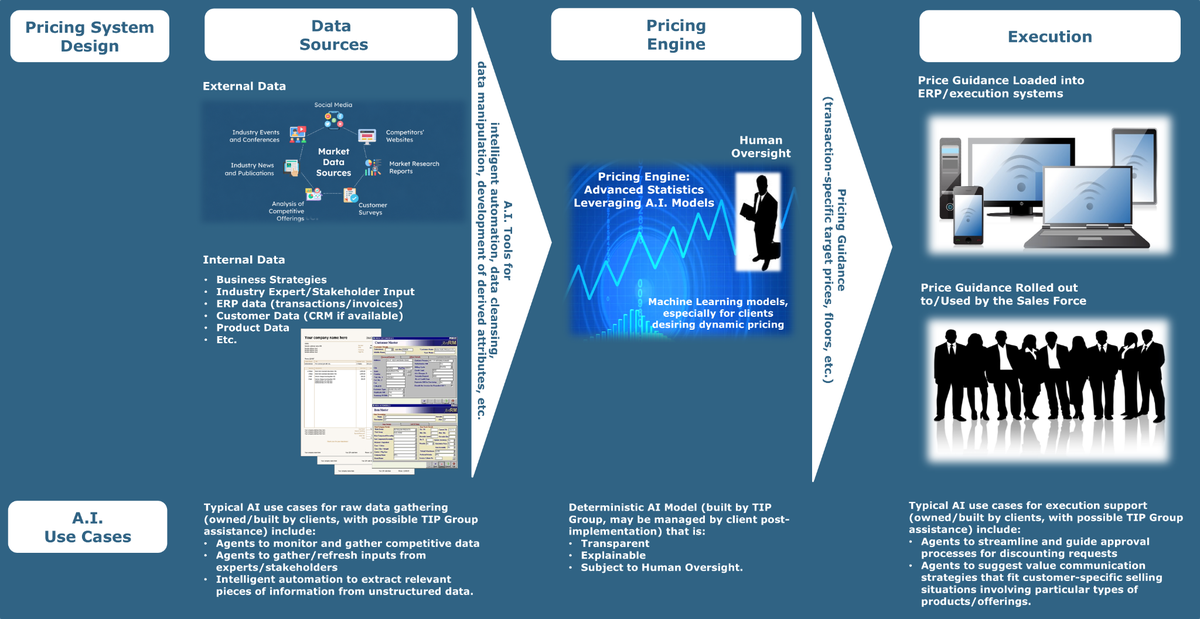
To manage dynamic pricing systems, Machine Learning algorithms may be leveraged
to continually keep pricing models up-to-date. If M.L is used, clients are
advised to ensure that a human remains in the loop. M.L. generated model logic updates
(such as changes to segmentation schemes, for example) should be reviewed by a human
prior to being moved to a production environment. The human should have
knowledge about the business, as well as about the model’s operation. This
approach helps ensure that model updates are understood, align with business
strategies, and A.I. “mistakes” do not disrupt operations.
A.I. Policies Related to Pricing Model Updates (Ongoing Pricing
Model Operation)
Once pricing is live, prices need to be updated regularly.
Price changes may be due to fresh inputs (cost data, customer data,
transactional data, competitive/market data, etc.), or refinements in the model
logic (updates to segmentation schemes or pricing factors such as
markups/margins or discounts).
Model input data updates are typically managed by clients. To
ensure that best available current data is leveraged, data update processes may
be supported by intelligent automation, including A.I. agents. Such processes
are best designed by clients who are knowledgeable about their source data and
systems. We are available to support efforts to create such processes if
clients seek such assistance, and we recommend that clients follow the core A.I.
policies outlined above related to transparency, explainability, and human
oversight.
Model logic updates are also typically managed by clients.
Upon request, we remain available to perform model updates, or to train new
client personnel on how to perform them. This approach helps substantially
minimize long term costs to our clients (many other pricing providers charge
hefty recurring subscription fees for model update services). As noted above,
M.L. tools may be leveraged to continually refine model logic in instances
where dynamic pricing is desired. Updating more stable (less dynamic) pricing
models typically requires less advanced sophistication levels in terms of
statistics and A.I. use.
A.I. Policies Related to Supporting Pricing Processes
In addition to model sophistication and fit, a pricing engine’s effectiveness
in driving performance is also impacted by the quality of inputs, and the
processes aimed to ensure that the pricing guidance is utilized in the context
of real life transactions. Clients are encouraged to leverage A.I. tools in
both of these areas. We are available to support relevant efforts upon request,
and we recommend that clients follow the A.I. policies outlined above.
For example, in the area of producing quality inputs, A.I.
tools can be leveraged to collect competitive data, or to clean transactional
data. In the execution area, A.I. tools
can be used to help streamline and guide approval processes for discounting
requests, or to suggest value communication strategies that fit
customer-specific selling situations involving particular types of
products/offerings. Given the significant variation in the dynamics across
different pricing environments, and the quick pace of change in relevant A.I.
technologies, the number and nature of possible application areas is extensive
and increasing.